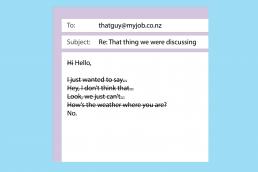
It isn’t copying, and it’s not ©opyright
Simply: copywriting is writing.
We use the sometimes-confusing term “copywriter” because when you say “writer”, people tend to think we’re talking about a novelist. Our copywriters contribute to creative projects such as novels and screenplays, but our toast and jam is professional writing for businesses.
“Copy” is a misleading word. In this context it does not have anything to do with replicating work. And don’t confuse “copywriting” with “copyright” (©: the protection of intellectual property).
Copy is the word we use to describe a piece of text. It can be used to describe the written contents of a web page, advertisement, book, article, or just about anything else with words on it.
Copywriting is part of your design toolbox, just as important as layout, imagery, fonts, colours and style.
Who uses copywriters?
Copywriting is traditionally associated with marketing and sales, but a wide range of people and industries use copywriters to write or edit:
- “About us” pages on websites
- Product/design/art descriptions
- Professional/freelancer bios
- Blog posts
- Newsletters
- Reports and updates
- Pitch letters
- Grant applications and competition entries
What do you get out of it?
Most readers leave a web page within in the first minute unless the first information they see grabs their attention.
People behave similarly for other media: binning or spamboxing emails with bad subject lines; tossing circulars from mailboxes without a second glance; glossing over newspaper articles in favour of the quiz pages; many people don’t even read important (but boring) letters from banks and insurance companies before they file them.
Good copy grabs your reader’s attention in those crucial first seconds, then holds it until they get the information they want or the information you want to give them. Good writing – or bad writing – is part of the user experience.
Good copy, bad copy
Everyone who took English in school thinks they write good copy. This is not true, but there is no shame in that. Copywriters have years of training and practice in fields such as journalism, marketing, communications, and literature.
Most people shouldn’t use their own writing for professional material, any more than they should use their amateur smartphone photos. A selfie might look fine on your Twitter profile, but a photo for your professional bio should be taken by a photographer with decent lighting and good equipment. Copy is the same: of course you can write your own emails, but anything the public sees should be written by a pro.
Have a look at these short fictional web bios:
John began his career as an accountant after graduating from the University of Canterbury and becoming a Chartered Accountant.
He later left this career path when he took a belated OE and worked for five years as a dive instructor in Thailand. This is when John first became interested in charity work, as he got to know many people who were involved in community development NGOs.
When John returned to New Zealand, he decided to become an accountant once again, but this time with a difference. He began by setting aside 10% of his work time for non-billable pro bono work for charities, and it eventually became his speciality.
John is now on the board of five well-known charities, as well as several other businesses.
John is a business advisor specialising in charities. He began his career as a Chartered Accountant, but a long stint as a dive instructor taught him there was more to life than numbers.
He now sits on the boards of five well-known charities as well as other businesses, and provides support to many more.
On the left, you can see the first mistake most people make: too much information.
It is natural and good to want to get all the available information about you, your product and your company out there into the world. Unfortunately, nobody wants to read 500 words about how your first shitty job made you realise your app idea could change the world.
A copywriter acts as an impartial third party. They can absorb all the information you have, and tell you what people are going to care about and respond to.
Jargon
GeneriCryptoCo’s new algorithmic indices provide a specialised, but familiar tool of standards for the digital age currencies space.
Our cryptosecurity system creates and applies measures leading to secure ciphers and codes, used to protect encryption systems and methods from enemy discovery, decryption, interception and tampering. This ensures messages and transactions retain full confidentiality and authenticity.
GeneriCryptoCo’s easy-to-use platform uses specialised technology to rate cryptocurrency-buying algorithms.
Our security system uses the latest encryption technology to prevent anyone from accessing your data. This ensures nobody but the recipient can see your messages, and your transactions are safe and private.
When you live and breathe your industry it is easy to lose track of what language your readers understand. Even people in your own sector might not understand jargon as well as you think they do. How many times have you been in a meeting and wanted to ask what a word or acronym means?
Copywriters are specialists at creating simple explanations and finding widely-understood alternatives to complex terms.
Structure
This financial year was off to a rocky start with a slow fall in sales through the first quarter. This was partially offset by selling assets including our original warehouse.
Expenditure increased significantly during the second and third quarters as we increased marketing and sales efforts, as well as spending considerable resources courting potential investors.
This strategy paid off in the fourth quarter. Monthly sales quadrupled, followed by a successful investment round in which the company’s value increased tenfold to $2 billion.
This very successful financial year has seen the company’s value increase tenfold to $2 billion.
An initial downturn in sales through the first quarter led us to significantly increase spending on marketing and sales through the second and third quarters, as well as investing resources into courting potential investors.
Monthly sales quadrupled in the fourth quarter, and the following investment round reflected the increase in value.
The order of your copy is important. In stories, the order helps you create a structured narrative. In web copy, it helps direct the reader to the information they want. In business documents, it helps the reader understand complex information by receiving it in a logical order.
In most cases we try to present the most important or exciting information first, followed by the context. You don’t need to follow a chronological order when telling a story.
But putting the most exciting info first isn’t always the best way to write. The example on the right below deliberately holds off the reveal to build suspense.
Today a thief tried to sell me the Mona Lisa.
Jean-Michel, a talented but inexperienced street thief who sometimes sold me specialist jewellery turned up at my back door this morning.
He looked nervous. He said he had come straight from a burglary, and the item was hot but he didn’t have anywhere to store it.
I told him he shouldn’t have come to me with the police probably on his tail, but he insisted I would be interested and the risk was worth it.
He then went to the car and pulled out the painting.
I opened my back door to find Jean-Michel, a talented but inexperienced street thief who sometimes sold me specialist jewellery he had picked up.
Today he looked nervous. He said he had come straight from a burglary, and the item was hot but he didn’t have anywhere to store it.
I told him he shouldn’t have come to me with the police probably on his tail, but he insisted I would be interested and the risk was worth it. He then went to the car and pulled out a canvas.
“Sacre bleu,” I said.
It was the Mona Lisa.
Copywriting is one of the professional services Wordshop offers. Get in touch if we can help you with your copy.